
“Sustainability” has never been a more popular word—and that’s both good news and a challenge. In 2026, stakeholders are demanding more than promises, campaigns, and one-time initiatives. They want proof. They want results. They want measurable change.
That’s where sustainability R&D becomes essential.
Unlike broad sustainability programs that can struggle to show clear ROI or impact, climate tech R&D and applied research can turn ideas into tested systems, deployable technologies, and repeatable methods. The outcome is the same thing every organization is being pushed toward: measurable impact.
In this article, we’ll break down what sustainability R&D looks like in 2026, why it matters more than ever, and how organizations can move from good intentions to measurable outcomes through environmental innovation.
Sustainability R&D Services in 2026: Why “Innovation” Must Be Operational
In previous years, “innovation” often meant pilots, prototypes, or brand positioning. In 2026, environmental innovation is increasingly judged by operational outcomes:
- What changed in the field?
- What improved in performance?
- What was measured and verified?
- What can be scaled?
Sustainability R&D services now sit at the intersection of:
- Data and measurement (what’s happening and why)
- Engineering and design (how to change it)
- Ecology and systems thinking (how to protect and restore)
- Community outcomes (who benefits and how sustainably)
In other words: sustainability R&D is no longer “nice to have”—it’s how organizations build credible, defensible sustainability programs.
Climate Tech R&D vs. Sustainability Commitments: The Difference Is Proof
A sustainability commitment might sound like:
- “We aim to reduce emissions.”
- “We support nature-based solutions.”
- “We will invest in innovation.”
A climate tech R&D approach asks:
- What is the baseline today?
- Which variables drive losses, waste, or emissions?
- What interventions can be tested under real conditions?
- What data proves outcomes after implementation?
This shift matters because modern stakeholders—partners, donors, regulators, customers, and communities—are increasingly aligned around one theme: accountability.
That accountability doesn’t require perfection, but it does require:
- clear measurement
- transparent assumptions
- repeatable methods
- trackable progress over time
That is exactly what strong sustainability R&D is designed to deliver.
Environmental Innovation That Delivers Measurable Impact Starts with Measurement
A lot of sustainability failures share the same root cause: they start with solutions before they define the problem.
The most effective sustainability R&D programs begin by asking:
1) What can we measure now?
Define baseline metrics such as:
- resource loss rates (water, energy, materials)
- operational inefficiencies and waste points
- ecosystem health indicators (where relevant)
- risk exposure (supply chain disruption, climate events)
2) What outcomes matter to stakeholders?
This is where “measurable impact” becomes practical. You don’t need dozens of metrics—you need the right ones:
- reduced losses
- improved productivity
- improved ecosystem resilience
- increased access to food or resources
- reduced emissions or environmental pressure
3) What intervention can be tested and repeated?
R&D becomes valuable when it generates solutions that work consistently in real environments—not just in ideal lab conditions.
Sustainability R&D Services That Scale: From Pilot to Repeatable Model
In 2026, the bar for sustainability innovation has moved from “Did you try something?” to “Can you scale it responsibly?”
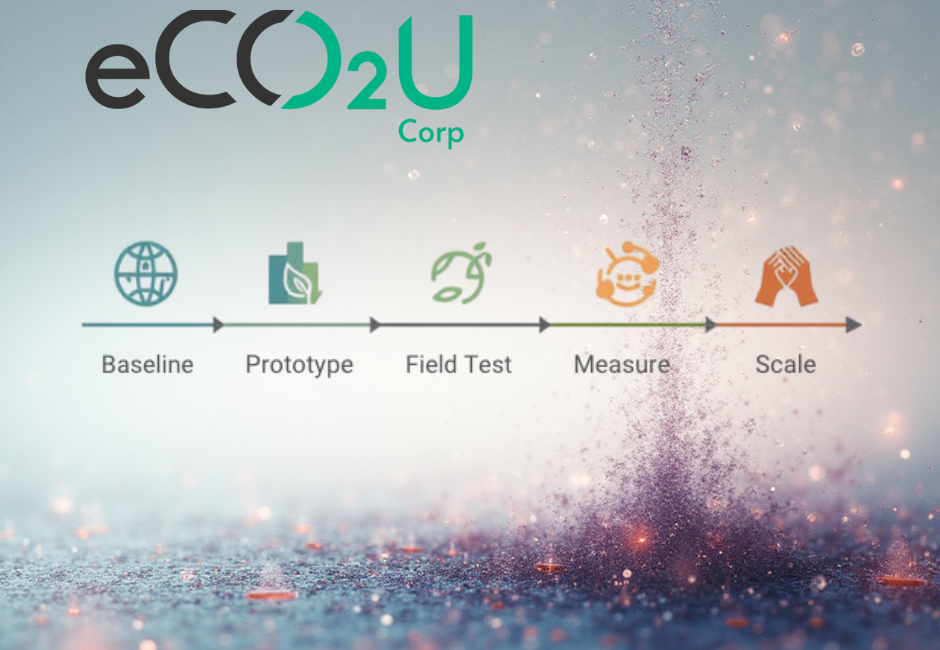
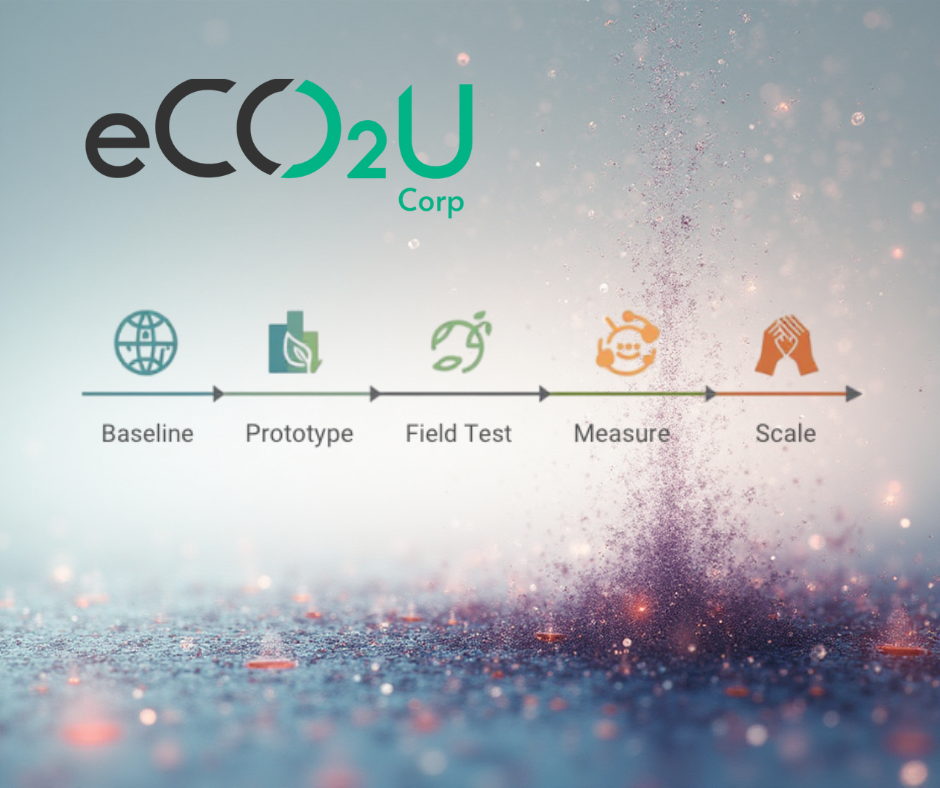
A strong R&D pathway often looks like this:
- Research phase: understand the system and define measurable baselines
- Prototype phase: develop intervention models (technical, ecological, or operational)
- Field validation: test in real conditions and measure performance
- Iteration: refine based on results
- Scaling plan: replicate with partners, funding, and operational playbooks
This approach reduces the risk of expensive pilots that never graduate into real-world adoption.
Measurable Impact Examples: Where R&D Creates Real Change
To make this practical, here are areas where sustainability R&D is already delivering measurable outcomes:
Reducing “invisible losses” in systems and operations
Many industries lose value through issues that aren’t obvious until they’re measured—temperature variation, handling inefficiencies, storage problems, or logistics gaps. R&D combined with monitoring and engineering design can reduce those losses substantially.
Natural backlink: eCO2U explores this approach through Sustainable Engineering, focused on converting invisible losses into measurable outcomes:
Sustainable Engineering – Turning Invisible Losses into Measurable Impact
Nature-based solutions tied to community and water security
Reforestation becomes more impactful (and more durable) when designed around measurable ecosystem outcomes and local development realities—particularly water availability, land use, and long-term stewardship capacity.
Food-system resilience that prioritizes local context
Sustainability innovation in food systems is increasingly centered on local ingredients, local knowledge, and community empowerment—especially when solutions are designed to adapt to real constraints rather than ideal assumptions.
2026 Sustainability R&D Priorities: What Leading Organizations Are Funding
If you’re building a roadmap, these are high-signal themes for 2026:
1) Measurement-first sustainability programs
Programs that begin with baselines and track progress transparently.
2) Resilience and risk reduction
R&D aimed at reducing exposure to climate volatility, supply disruptions, and ecosystem degradation.
3) Technology + ecology together
Not “tech vs. nature,” but systems where climate tech supports ecological restoration and protection.
4) Real-world validation over theoretical performance
Field-tested performance is becoming a credibility requirement.
5) Solutions designed for adoption
The “best” solution isn’t the most advanced—it’s the one that communities and operators can actually sustain.
How to Build a Sustainability R&D Roadmap That Survives Scrutiny
If your organization wants measurable outcomes, treat your sustainability R&D roadmap like an engineering plan—not a marketing plan.
A simple framework:
- Define the system: where are the biggest losses, risks, or degradation points?
- Choose measurable outcomes: select metrics you can track consistently.
- Design interventions: technical, ecological, operational, or a combination.
- Validate in the field: prove impact with data.
- Plan scaling early: replication, partnerships, training, funding, governance.
This is also where collaboration matters: the most credible environmental innovation work often comes from cross-disciplinary teams (engineering, ecology, community practitioners, data systems, and implementation partners).
Moving Beyond Intentions: 2026 Is the Year of Measurable Outcomes
Good intentions are a starting point—but they are not a strategy.
In 2026, sustainability R&D is the bridge between aspiration and proof. It is how organizations produce environmental innovation that can stand up to scrutiny, scale responsibly, and create measurable impact that benefits both people and ecosystems.
Ready to Turn Sustainability into Measurable Impact?
If you’re looking to move from high-level sustainability goals to real-world, data-backed outcomes, eCO2U can help design and support R&D initiatives that connect technology, ecology, and implementation.
Learn more about our work in applied innovation here:
Sustainable Engineering – Turning Invisible Losses into Measurable Impact
Learn more through eCO2U—and let’s build measurable outcomes together.